
Did you miss our Webinar on Bone Turnover Markers?
Here’s something that may be surprising to you: your entire skeleton gets a complete makeover roughly every decade. It’s like your bones are running their own renovation show, except instead of shiplap and tile, we’re talking about calcium and collagen. The crew members making this happen? Cells called osteoblasts (the builders) and osteoclasts (the demo team). And the debris they leave behind—those are bone turnover markers.
In a recent Euroimmun US Academy webinar titled “BTMs Uncovered: Turning Lab Numbers into Clinical Insights“, bone health experts Dr. Paul Miller from the University of Colorado and Dr. Jennifer Kelly from the University of Vermont pulled back the curtain on how they actually use these markers in clinical practice. Spoiler: these markers are super versatile and provide clinicians with valuable information on their patients with bone disease.

What are Bone Turnover Markers (BTMs)?
Think of bone turnover markers (BTMs) as your skeleton’s real-time activity tracker. While a DEXA scan gives you a snapshot of bone density—like a trustworthy bank statement at the end of the month—BTMs show you the transactions happening right now. Are you depositing bone (formation) or withdrawing it (resorption)?
In a healthy skeleton, these processes balance out like a well-managed budget. But when resorption starts outpacing formation, you can be heading toward bone loss and potentially osteoporosis without even knowing it. Osteoporosis is a silent disease until something breaks… and then it screams. That’s where bone turnover markers become invaluable.
Now, let’s be clear: BTMs won’t diagnose osteoporosis, osteopenia, Paget’s disease, or chronic kidney disease-associated bone disorders—that’s still DEXA scan territory. But once you’ve made the diagnosis and begin managing these conditions, BTMs become a clinician’s secret weapon for monitoring treatment effectiveness, catching patients who’ve stopped taking their meds, and predicting both fracture risk and treatment response.
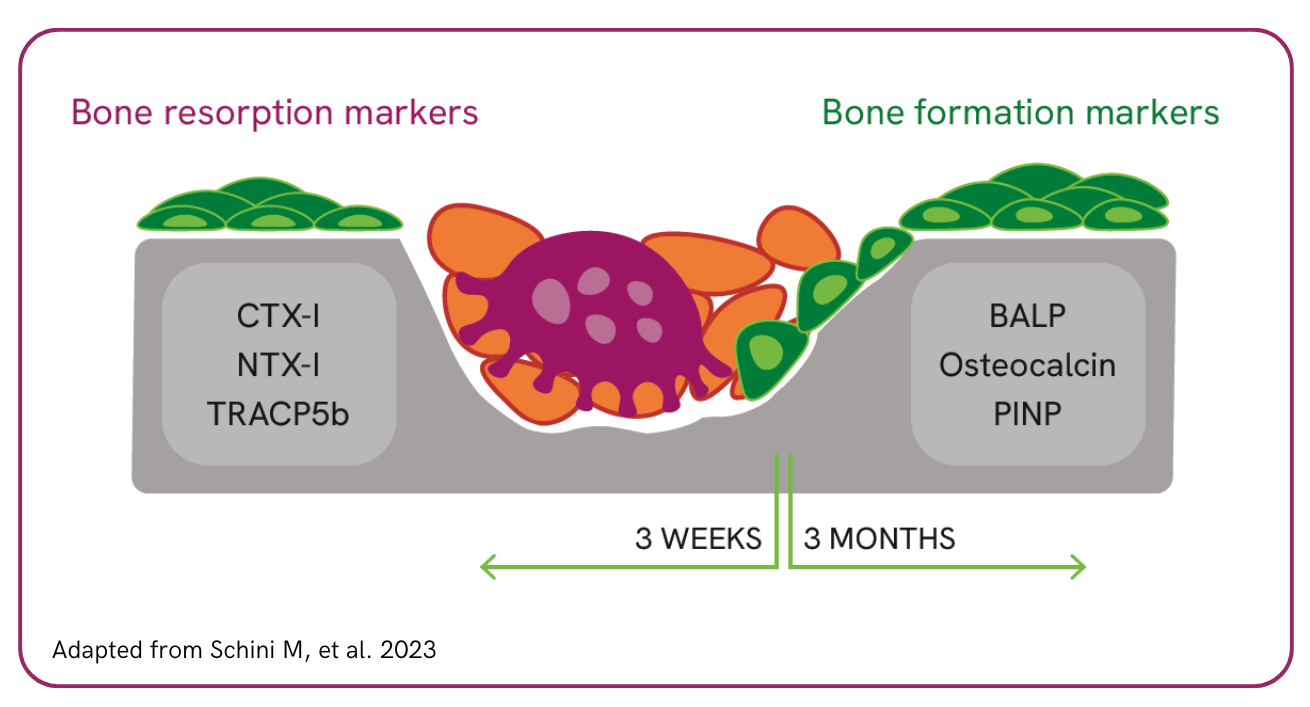
Bone is broken down by cells called osteoclasts which results in the release of resorption markers CTX-I, NTX-I and TRACP5b. On the other hand, bone is created by osteoblasts, resulting in the release of formation markers BALP, Osteocalcin, and PINP. While these processes are coupled, their timelines are approximately 3 weeks and 3 months, respectively.
Key Takeaways from this Bone Webinar
Timing matters. You can measure bone turnover markers just three months after starting osteoporosis treatment. Compare that to waiting a full year for meaningful bone mineral density scan results. It’s the difference between adjusting your course early versus hoping you’re headed in the right direction. Plus, some patients won’t stick around to find out.
Versatility is key. Whether you’re using anabolic therapy (bone-building drugs), anti-resorptive therapy (drugs that slow bone breakdown), or managing those tricky drug holidays in osteoporosis treatment, a variety of bone turnover markers give clinicians feedback along the way.
Prediction power. These bone markers don’t just tell you what’s happening now—research suggests BTMs can actually predict future fractures or even how well someone will respond to treatment. That’s pretty remarkable when you think about it.
New guidelines are here. Updated recommendations from the International Osteoporosis Foundation (IOF) and International Federation of Clinical Chemistry and Laboratory Medicine (IFCC) reaffirm CTX-I and PINP as your go-to markers when kidney function is normal.¹ When chronic kidney disease is at play, the focus switches to BALP, TRAcP5b, and intact PINP instead.
The research continues. We still need more work establishing reference intervals for bone markers like TRAcP5b and intact PINP—science is always evolving, and that’s a good thing.
What Attendees Walked Away Knowing about BTMs
Participants learned the bone physiology basics—how bone turnover markers actually reflect what’s happening in your skeleton moment to moment. Our speakers explained when BTMs are most helpful across conditions like osteoporosis and chronic kidney disease-mineral bone disorder (CKD-MBD).
Dr. Miller also broke down his timeless 2022 New England Journal of Medicine piece on whether to continue bisphosphonate therapy beyond five years—a genuinely practical question that clinicians wrestle with regularly.² And Dr. Kelly highlighted what’s new in the latest IOF-IFCC guidelines, giving everyone a clear picture of current best practices.³
Watch the Full Webinar On Demand
Missed the live session? No problem. The full webinar is available on demand, ready to show you how bone turnover markers can genuinely transform the way we assess and manage skeletal health. Because your bones are working hard behind the scenes—shouldn’t we understand what they’re up to?
Click here to check out the full library of Euroimmun US Academy webinars.
References
- Bhattoa HP, et al. 2025. Osteoporosis International 36: 579-608. doi: 10.1007/s00198-025-07422-3
- Chang LL, Eastell R, and Miller PD. 2022. N Eng J Med 386:1467-69. doi: 10.1056/NEJMclde2115900
- Schini M, Vilaca T, Gossiel F, et al. 2023. Endocr Rev 44(3):417 – 473. doi: 10.1210/endrev/bnac031